BMW E30 M3
The homologation special that started everything: a hand-built four-cylinder touring car with box arches, a steeper rear glass and a chassis that still teaches modern cars manners.
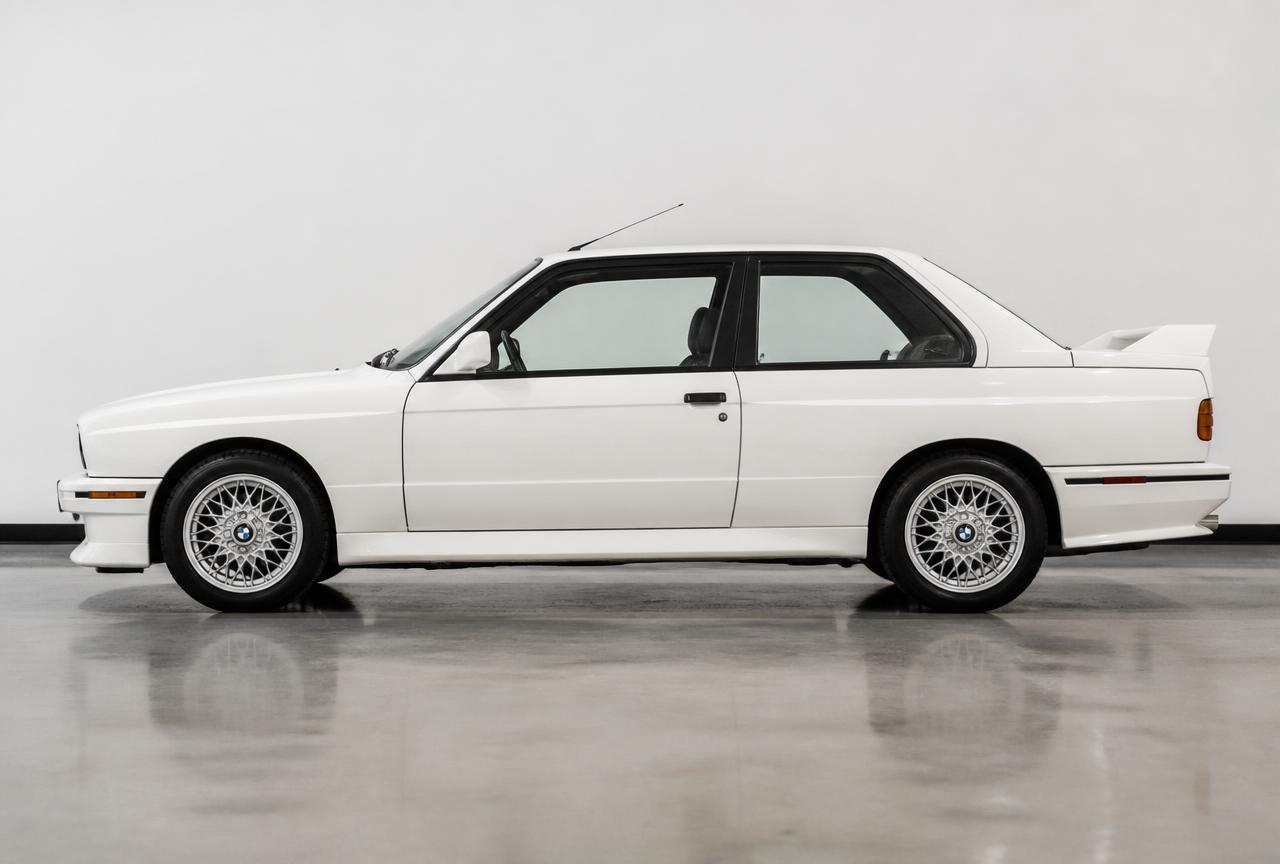
The E30 M3 exists because BMW needed 5,000 road cars to go Group A touring car racing. Almost nothing on it is shared with a standard E30 apart from the doors, hood and roof panel — the arches, bumpers, trunk lid, rear window rake and spoilers are all M-specific aerodynamic work, and the S14 engine is effectively an M88 six with two cylinders removed.
It is the slowest car in this guide by modern numbers and the one most owners describe as the most rewarding. The S14 wants 7,000 rpm, the steering is unassisted enough to feel the road surface change, and the chassis rotates on throttle in a way that later, heavier M3s cannot replicate. Buy it for that, not for straight-line speed.
Values moved from used-BMW money to collector money over the last decade, which changed the buying calculus completely: a cheap E30 M3 is now the most expensive way to own one. Condition, originality and documented history matter more than mileage.
Year by year
- 1986–1987 — early cars
195 hp Euro spec (192 hp US from 1988). Early cars have the smaller 'small bumper' look in Europe, no airbag, and the pure early interior. Evolution I and Evolution II homologation runs added aero and power in Europe only.
- 1988–1989
US cars arrive with catalytic converters and 192 hp. Interior gains an airbag steering wheel late in the run. Sport Evolution (Evo III) arrives in Europe with a 2.5L S14 and 238 hp, plus adjustable front and rear spoilers.
- 1990–1991 — late cars
Best-equipped and most refined of the run. Many late cars received the improved cooling and later gearbox refinements. Cabriolets were hand-built in tiny numbers and are Europe-only.
The good and the bad
Positives
- +Steering feel and chassis balance that nothing built since has matched
- +S14 loves revs and sounds like a detuned Formula 2 engine
- +Hand-built body and homologation pedigree — a genuine motorsport artifact
- +Simple, mechanical maintenance any competent independent can handle
- +Values have proven resilient; the strongest cars are treated as investments
Negatives
- −Expensive to buy and increasingly expensive to repair correctly
- −M-specific body panels are scarce and cost several times E30 equivalents
- −Slow by modern standards; highway cruising is loud and busy
- −Rust in the usual E30 spots is common and structurally serious
- −Reproduction and 'tribute' cars circulate — verification is essential
Known faults and what they cost
- Rust: rear shock towers, jacking points, windscreen surround, battery tray$3,000–$25,000+
The single biggest financial risk. Rear shock tower and subframe mount corrosion is structural, and proper repair means shell work.
- S14 timing chain guides and rod bearings$2,500–$5,000
Chain guides wear on high-mile engines; rod bearings are a wear item on hard-driven cars. Budget an inspection at purchase.
- Valve adjustment and head wear$400–$800 per service
The S14 has mechanical shim-over-bucket valve adjustment; neglect leads to burnt valves and head rebuilds.
- Original bumper trim, glass and interior parts$500–$4,000 per item
M-specific trim is discontinued. A cosmetically tired car is genuinely hard to make right.
Pre-purchase inspection checklist
- 01Put it on a lift and inspect rear shock towers, subframe mounting points and floors from underneath
- 02Verify the VIN and body number against BMW records and the S14 engine number
- 03Compression and leak-down on the S14 — expect even numbers across all four cylinders
- 04Confirm the 25-tooth vs 40-tooth ABS ring and correct M-specific suspension parts are present
- 05Check panel gaps and paint depth across the arches for accident or tribute-conversion evidence
- 06Ask for valve adjustment records and a receipt trail, not just a claim of 'recent service'
Modifications for longevity
- Rust prevention
Cavity wax the shell, keep drains clear and store dry. Nothing else matters as much.
- Rod bearings and chain guides
Preventive replacement around 100–120k miles or on any engine with unknown history.
- Cooling system overhaul
Radiator, hoses, water pump, thermostat and expansion tank as a set every 8–10 years.
- Rear subframe reinforcement
Inspect mounts; reinforce if the car sees track duty or slicks.
- Correct fluids and valve adjustments
Valve clearance every 15k miles; quality oil on a 5k interval.
Modifications for performance
- 01Keep it stock
Original cars carry a value premium. Store the OEM parts if you modify anything.
- 02Suspension and tires
Modern 15"/16" tires, Bilstein or Koni dampers with correct springs, fresh bushings. The biggest real-world gain by far.
- 03Intake, exhaust, tune
Individual throttle body sync, a free-flow exhaust and a chip take a US car to roughly 210 hp with excellent driveability.
- 042.5L stroker
S14 2.5 builds deliver 250–280 hp with Evo-like character, but cost as much as a decent used car and hurt originality.
What they are worth
Project and needy cars still trade in the five figures but almost always cost more to finish than a sorted car costs to buy. Driver-quality cars with honest paint and documented mechanical work occupy the middle of the market and are usually the smartest purchase.
Concours, low-mileage and special-edition cars (Evo II, Sport Evolution, Cecotto, Europameister) sit in a separate tier that tracks the collector market rather than the enthusiast one. Documentation and originality drive those results more than mileage.
Owner discussion
0- No comments yet. Be the first.